In short. A decision letter is the part of a selection programme that every applicant reads. A letter applicants respect states the decision in its first line, gives a reason in plain words, tells the person exactly what happens next and by when, and arrives on the date that was promised. Accept, waitlist and decline letters each have a different job, and each fails in a different way. Test them before sending, and keep a record of what went to whom.
Reviewers and committees put weeks into a decision, then often spend ten minutes on the letter. For the applicant it is the reverse: the letter is the only thing they will see. A fair process that ends in a confusing, late or wrongly addressed letter feels unfair, and a modest process that ends in a clear one tends to be remembered kindly, even by those who were declined.
What Every Decision Letter Needs
Whatever the outcome, six elements make a letter work:
- The decision in the first sentence. Do not make the reader scroll past three paragraphs of thanks to find out.
- The programme and the round, so a person who applied to several can tell which this concerns.
- A short reason the applicant can understand.
- What happens next, with dates.
- A named contact or a reply address that is actually read.
- A tone that matches the news: warm for acceptance, honest for decline, clear for waitlist.
Keep each letter to one screen on a phone. Most applicants will open it there.
The Accept Letter
An acceptance has to turn excitement into action without hiding the conditions. Include:
- The decision and, if it is a grant or place, the amount or terms.
- A deadline to confirm, and what happens if the applicant does not reply. Seven to fourteen days is usual.
- Documents or details you still need from them.
- The date of the first event, such as onboarding, a kickoff call or a start of term.
- A line on what to do if they cannot accept, so the place can be offered to someone else promptly.
The common failure is an acceptance that reads like a receipt. Another is a deadline to confirm that falls before the applicant could reasonably have read the letter.
The Waitlist Letter
The waitlist is the hardest letter to write well, because it says neither yes nor no. Applicants read it as hopeful or as polite rejection depending on how clear you are. Say:
- That the application is strong enough to be held, and that no decision has been made against it.
- The applicant's rank on the list, if you give one. A number such as "you are third on the waitlist" lets people plan. If you do not intend to share rank, say so.
- When they will hear. Give the date by which the first-round places are confirmed, and the date after which the waitlist closes.
- What will trigger an offer, such as a declined place, and how quickly they will need to respond.
- That they may withdraw at any time without penalty.
Rank deserves care. A waitlist ordered by score at the moment of the committee meeting should be kept in that order, and any change to it should be recorded with a reason. When a place opens, the next person on the list is offered it. If the order is quietly changed, the waitlist stops being fair.
The Decline Letter
A decline is where respect matters most and where the temptation to be brief is strongest. A decline letter should:
- State the decision plainly: "We are not able to offer you a place in this round."
- Give one honest, general reason, such as the number of strong applications against places, or the criteria on which the application scored lower.
- Offer feedback that helps (see the next section) or say plainly that individual feedback is not available.
- Say whether the person may apply again, and when the next call opens.
- Avoid phrases that blame ("unfortunately you failed to") and avoid false comfort ("your application was excellent") when it was not.
Feedback That Helps
Applicants who are declined value feedback more than anything else in the letter, and it is easy to get wrong. Good feedback is:
- Specific to a criterion. "The commercial plan did not show how the first customers would be reached" is more useful than "the proposal lacked clarity".
- Drawn from the scoring, not from a reviewer's passing remark. Use the criteria in the published rubric.
- Anonymous. Never name the reviewer or quote a comment that would reveal who wrote it.
- Short. Two or three points are enough. A page of comments reads as a criticism.
- Forward-looking. One line on what would make the next application stronger.
If you cannot give individual feedback for every applicant, give a summary of what the strongest applications had in common. It costs little and many applicants find it useful.
Timing
Dates matter as much as words. A letter that arrives on the day the call document promised is trusted. A letter that arrives three weeks late undoes the goodwill of the rest.
- Publish the notification date in the call and keep to it.
- Send all letters in one batch, or in a clearly announced order. If acceptances go out on Monday and declines on Friday, applicants will guess.
- Avoid sending on a Friday evening, when nobody on your team can respond to a question.
- Warn the team a day before, so the support inbox is ready.
- Give accepted applicants time before the confirmation deadline, and send a reminder halfway through.
Test Before You Send
Letters go wrong in small, specific ways. A merge field prints as raw text. The waitlist number is blank. A decline template goes to a person who was accepted. Run through this list on every batch:
Then spot-check three real letters from each outcome before the full send. It takes twenty minutes and prevents the errors people remember.
Keep a Record of What Was Sent
When an applicant says "I never received it" or "I was told something different", you need to answer from evidence. Keep:
- The text of each template version used.
- A list of recipients, outcome and date and time of sending.
- Delivery status, including bounces, so that people with bad addresses are contacted another way.
- Any later changes, such as a waitlist offer, with the reason.
This record also protects the programme in a complaint, because it shows that the same process was applied to everyone.
Where IdeaScore Fits
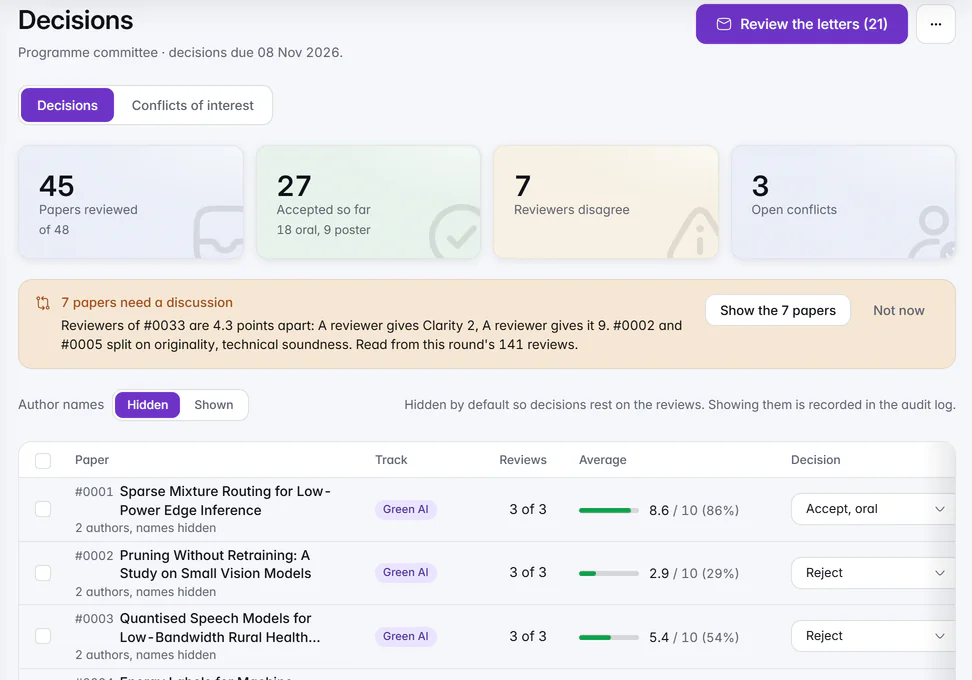
IdeaScore treats letters as part of the decision, not a separate task. Committee outcomes of Accept, Waitlist or Decline feed the letters, which can use fields such as the waitlist rank, and "Send a test to me" lets you read a letter exactly as an applicant would before anything goes out. A "Check before you send" step catches problems ahead of the batch, and the Decision Trail keeps a record of what was decided and sent. Where IdeaScore AI has helped with the review, the letter says so in plain words, and people make every decision.
Questions Programme Officers Ask
Should we explain every decline? A general reason is enough for most calls. Individual feedback is a courtesy, and worth giving where the numbers allow.
Can we share the waitlist rank? Yes, and most applicants prefer it. Decide in advance and say so in the call.
What if an applicant disputes the decision? Point to the published criteria and the process. If a process error is found, correct it and write to everyone affected.
How soon after the committee meets should letters go out? As soon as outcomes are confirmed and checked, within the date promised. A few days is normal. A few weeks is not.